Effective imprisonment in Belgium: how effective is “effective”?

Many offenses can be punished under the Criminal Code with an effective prison sentence. We are regularly asked whether an offender must actually go to prison when sentenced to an effective prison term. In this news blog, we are pleased to provide you with an update on this.
Total prison sentences of more than three years
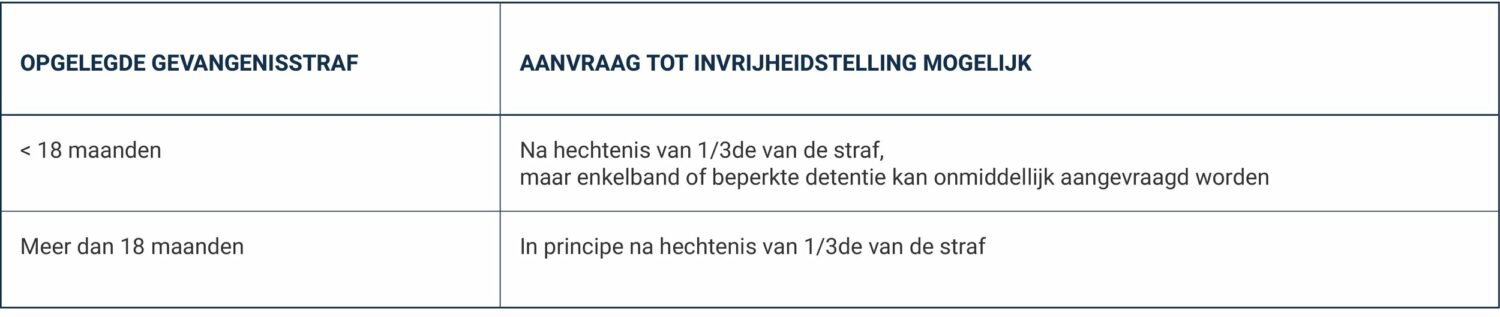
Anyone with a total sentence of more than three years’ imprisonment must serve that sentence in prison. The execution of these prison sentences falls under the jurisdiction of the Sentence Enforcement Court (SEC). In principle, a detainee with a total sentence of more than three years may ask the SEC to be conditionally released after having served 1/3 of the sentence. The SEC examines this request for conditional release. In deciding whether the detainee can be released, the SEC takes into account, among other things, the detainee’s reintegration plan. If the SEC decides that a detainee may leave prison, it may attach certain conditions to that release. In this way, the detainee continues to be monitored after leaving prison.
Total prison sentences of less than three years
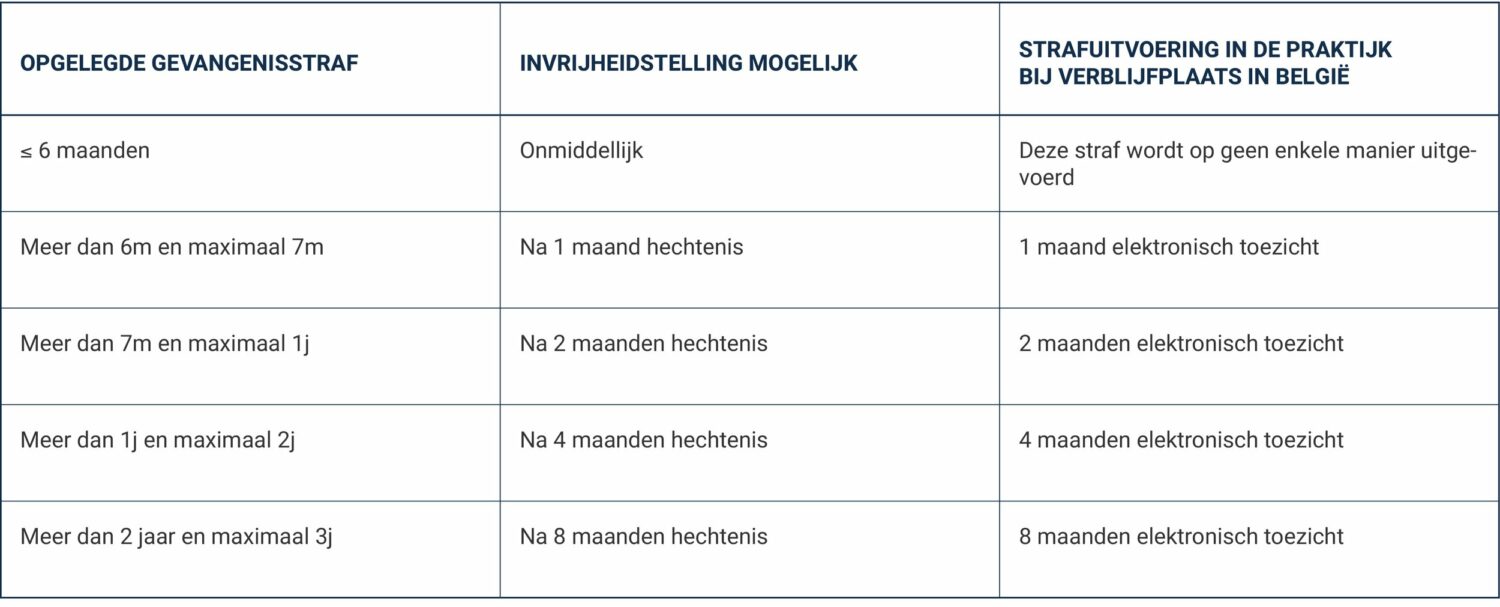
Anyone with a total sentence of three years or less, until recently, in principle did not have to go to prison at all. In practical terms, a detainee sentenced to a short prison term could be released after the periods stated below had elapsed. This happened automatically, without any review of a possible reintegration plan and without supervision by a court. It was not a judge, but the prison administration, that followed this up. An outstanding sentence of three years or less was (if the convicted person has a place of residence in Belgium) almost always served with an electronic ankle monitor due to prison overcrowding.
First phase of the execution of short prison sentences enters into force
It had long been the intention to put an end to this arrangement. Since September 2022, convicted persons with a total sentence of more than two years and less than three years are supervised by the sentence enforcement judge. They are no longer automatically released after serving eight months of their sentence. From now on, a judge will decide, on the basis of the reintegration plan, whether and when the detainee can be released. In principle, a detainee may ask the sentence enforcement judge for conditional release after serving 1/3 of the sentence. Six months before that date, they may also request to serve the remainder of the sentence under electronic monitoring or apply for limited detention (meaning the person may leave the prison during the day, but must return there to sleep at night).
This new arrangement applies only to convicted persons who must serve exclusively sentences handed down from September 2022 onwards. Sentences imposed earlier remain subject to the old regime.
From (no later than) September 2023 zullen ook de veroordeelden met een straftotaal van 2 jaar of minder opgevolgd worden door een strafuitvoeringsrechter. Er zal dan komaf gemaakt worden met de automatische invrijheidsstelling. De strafuitvoeringsrechter zal, in tegenstelling tot de gevangenisdirectie, rekening houden met verschillende elementen (de mogelijkheid om in eigen inkomsten te voorzien, de houding ten aanzien van slachtoffers,… ).
De effectieve gevangenisstraf zal dus een stuk ‘effectiever’ worden.
Prison overcrowding
At least that is the intention. In practice, however, the problem of prison overcrowding still persists. If short sentences are now also to be served in prison, even more detainees will be added to prisons that are already overcrowded. The Belgian State has already repeatedly been convicted over poor living conditions in prisons, with overcrowding being one of the key issues.
Minister of Justice Van Quickenborne announced that more prisons, as well as detention houses, will be created to remedy this problem. Certain groups of detainees can be supported in detention houses from day one, for example in finding work and housing with a view to their release. Research shows that this approach reduces the risk of reoffending. Those who receive additional support at the end of their sentence with a view to reintegration into society are less likely to commit new offences. It is, of course, in everyone’s interest that there are no new victims. A first detention house has recently opened in Kortrijk, with more to follow later. However, this will still take some time. The practical problem of overcrowding is therefore far from solved at this time. Whether the enforcement of short prison sentences is also practically feasible today remains an open question.